

✈️ The VIP Seat Weekly
Your business aviation hot takes, served fresh.
September 2nd, 2026 | Season 3 Episode 35 Companion
Good morning and welcome back to the VIP Seat. This week we have two $10 billion stories, with Vista weighing a European IPO and Apollo buying into Atlantic Aviation, plus OneFlight implementing and rescinding a 35% surcharge inside a single day, a new Treasury rule that pulls aircraft LLCs out of beneficial ownership reporting, and wingwalking robots going to work on a Michigan ramp. Sit back, buckle up, and let's take off.
Listen Now: Spotify | Apple Podcasts | YouTube
Today's Newsletter is brought to you by AB Jets

Today’s episode covered premium products. Premium FBO’s, premium flying… well here is one that actually shows up: the AB Jets Starlink-equipped Challenger 3500.
AB Jets did not just say they wanted new. They wanted new new. Brand new Challenger 3500s with Starlink, beautiful interiors, and everything else you would want when you are putting a high-end customer on an airplane.
Owner-operated since 1999, ARGUS Platinum since 2014. When the owners are the ones who built the operation from the ground up and are still running it today, the standard doesn't slip. Because it's their name on it. New Challenger 3500s, a fleet of Lear 60's that are reliable, and no owner approval requirements. A fleet optimized to say "yes" to your trips.
Give them a call when you need a really high-end experience for your charter customers. Thanks to AB Jets for sponsoring this season of The VIP Seat podcast!
Learn More At abjets.com
💰 Vista Weighs a $1 Billion European IPO

Gif by spongebob on Giphy
The Scoop: VistaJet and XO parent Vista Global Holding is exploring a European listing that could raise more than $1 billion and value the business at over $10 billion, according to Bloomberg reporting cited by Private Jet Card Comparisons. The UAE-based group is reportedly working with Bank of America, UBS and UniCredit, with Milan and Zurich named among the venues under consideration and a listing potentially taking place next year. Vista has confirmed that it appointed advisers and is assessing a range of strategic alternatives including a possible European listing. The discussions are described as early stage, and size, valuation and timing could all change. A listing would also create a liquidity path for existing financial investors, including RRJ Capital, which led a $600 million investment last year through convertible preference shares that convert to ordinary stock upon a listing, and Rhone Group. Founder Thomas Flohr remains the controlling shareholder. Reports of a Vista IPO have surfaced before, in 2021 and again earlier this year, without a transaction following.
Our Take: What follows is commentary and opinion, not investment or financial advice.
Round numbers first. A $10 billion valuation with a raise of up to $1 billion is roughly 10% of the company. But what that money is for? The last equity raise helped pay for restructuring debt. Using listing proceeds to keep working on the debt stack is a different story than listing because the business is compounding and the equity is going to rip.
There is also a pusher on the other side. The convertible preference shares raised previously turn into ordinary stock when Vista lists, which means the investor group has a rational interest in seeing this get done.
Now here’s the steel man argument. This is a company at genuine scale. Roughly 117,400 flight hours for Vista's US operators last year, vs. ~700,000 for NetJets and ~284,000 for Flexjet. Third place in that field is still a large business, and Vista's international footprint is something almost nobody else has. Meanwhile, the fractionals have largely stopped selling jet cards, which leaves a gap for whoever can deliver scale, quick callouts, large cabins and a consistent product on demand. If the wealth transfer tailwinds are real and Q3 and Q4 land the way the sector is hoping, then going to market now is the logical move rather than a defensive one. You pay a premium to fly Vista, and premium is exactly the product that gap wants.
Read More: Private Jet Card Comparisons
🔔 Ring the M&A Gong: Apollo Buys Into Atlantic at Nearly $10 Billion

Gif by theshadowsfx on Giphy
The Scoop: Apollo (NYSE: APO) and KKR (NYSE: KKR) announced a strategic partnership to support Atlantic Aviation's continued growth on August 27. Apollo-managed funds have acquired a significant interest in the company, while KKR-managed funds remain a substantial shareholder. Per the release, the transaction values Atlantic Aviation at nearly $10 billion. Atlantic is one of the largest FBO networks in the United States, providing fueling, hangar leasing and related services under long-term airport concession agreements. Apollo partner David Cohen pointed to the company's footprint at the nation's busiest airports and to structural tailwinds in private aviation. KKR partner Dash Lane noted that since KKR's 2021 acquisition the business has expanded through acquisitions and organic growth. Atlantic CEO Jeff Foland called the deal a validation of what the team has built. Paul, Weiss served as legal counsel to the Apollo funds, with Evercore and Morgan Stanley as financial advisors and Kirkland & Ellis as legal advisor to KKR.
Our Take: Two $10 billion headlines in one week! Congrats to everyone who made a bunch of money, including all the advisors on this deal.
Before you call the number crazy, let’s do some math. KKR bought Atlantic in 2021 at a reported $4.5 billion with 69 locations. The network is now north of 105. On a per-location basis that is a materially smaller step up than the headline implies, even before you account for what has happened to fuel volumes and service fees in that window. Only on the VIP Seat do you hear somebody say roughly $5 billion of appreciation is not that much money.
Infrastructure capital in this sector is bidding on two names, Atlantic and Signature, and trading them among themselves. Mid-sized chains are not drawing the same attention from big funds. Independents are still around 45% of US FBOs and the big chains sit somewhere near 12% of the total count by some estimates, but we think count is the wrong metric. They own the locations that drive volume, which is exactly why Teterboro comes up in every one of these conversations.
The part worth watching is the exit math. If this trades near $10 billion with meaningful leverage, the next buyer needs a path to something well north of that to hit their return target, and there are only so many levers on an FBO. Volume is one. Fees are the other. That is the same question listeners and readers pushed back on on social media when we discussed the duopoly a couple of weeks ago, and we think it is a fair one to keep asking.
Also worth tracking: Senators Blumenthal and Warren wrote to the FAA in June about private equity consolidation in the MRO space. The FAA is not an antitrust agency, but it does hold grant funding and project approvals, and that is a lever if anyone decides to use it.
The M&A gong is brought to you by Oshman Aviation. Thanks for sponsoring the gong.
Read More: Apollo
💸 OneFlight Implements, Then Rescinds, a 35% Surcharge

Gif by Ajsreactions on Giphy
The Scoop: Denver-based jet card broker OneFlight International emailed contracted-rate clients announcing a 35% economic surcharge on flight reservations, effective immediately, describing it as a response to extraordinary economic pressures currently affecting private aviation, per Private Jet Card Comparisons. The email said the company recognized this was a meaningful change and had delayed implementing it as long as possible. Hours later, a second email went to jet card customers saying that after hearing client feedback and careful consideration, OneFlight had decided not to implement the surcharge. OneFlight is known for frequent discount promotions, its ad campaign fronted by Shark Tank's Robert Herjavec, and high-profile sponsorships including a multi-year partnership signed in January.
Our Take: Doug Gollan, who is quick on the breaking news, could not get the increase published before they issued the retraction. What a quick round trip!
Set the surcharge aside for a second and look at the promotional calendar behind it. Reading down the 2026 headlines in the order they appeared: a $50,000 flight credit bonus on a $250,000 card in January, light jet cards at $5,500 an hour in February, discounted supermids, a large cabin card with hours priced around $10,000 including FET, midsize hours in the $6,000 range, $500,000 in credit for a $250,000 deposit, and several packages advertised with no fuel surcharge and a two-year use window. That list runs to something like fifteen promotional incentives in 2026 alone.
When hours sell below what the lift costs, the gap has to close somewhere, and a surcharge is one place it can show up. We do not know OneFlight's unit economics.
Jessie's read is the practical one for buyers: the headline number is marketing, the contract is the product. Availability, fuel surcharge language, peak day treatment, membership fees, expiration. If the contract does not lock it, you do not have it. And the loss-leader playbook has been run in this industry before by companies whose names you remember, on the theory that you buy the customer now and monetize later. In a commoditized business, the customer you bought on price is the customer who leaves on price.
The cost side is worth noting too. A PGA Tour title sponsorship, a Formula One partnership and a national television campaign is a lot of customer acquisition spend to carry.
Read More: Private Jet Card Comparisons
🏆 Treasury Takes Aircraft LLCs Out of Beneficial Ownership Reporting

Giphy
The Scoop: A new Treasury rule means US LLCs, corporations and other entities commonly used in aircraft ownership structures are no longer subject to beneficial ownership reporting under the Corporate Transparency Act, AIN reports. FinCEN issued the final rule on August 11, effective August 14, adopting with limited changes the interim final rule from March 2025. The rule permanently exempts domestic reporting companies from beneficial ownership information reporting, exempts reporting companies from reporting that information for US-person beneficial owners and company applicants, and relieves US persons from updating or correcting information previously submitted. Only non-exempt entities formed under foreign law and registered to do business in a US state or tribal jurisdiction remain subject to the requirement, and only as to their non-US-person owners. FinCEN has also said it will delete previously reported US-person information from the database.
Our Take: We wanted a practitioner on this rather than our own reading of a rule summary, so we brought on friend of the pod Chad Gilson of Gilchrist Aviation Law. What follows is his explanation, presented as his view, and none of it is legal advice for your structure.
In his telling, the CTA came out of the 2020 anti-money laundering legislation and required entities to report ultimate beneficial ownership directly to FinCEN starting in 2024. Litigation followed, the March 2025 interim rule paused the requirement for domestic companies, and this final rule locks that in. His read is that reporting now reaches only foreign entities registered to do business here, which as applied to US aircraft ownership is a very small slice given the FAA's existing citizenship requirements.
Two things worth sitting with. First, that window between 2024 and the 2025 interim rule was real. Second, on the deletion of previously submitted data, his observation was dry and fair: FinCEN has the obligation, it has said it will not confirm deletion to individual requesters, and the rest are left trusting that the button gets pushed.
Now the part that matters most for anyone who read this rule as a privacy win.
It is not one.
The reason ownership names surface on the tracking and data sites has nothing to do with the CTA. It is the FAA's own registration requirements: register an aircraft in an LLC and you disclose the membership and management chain to the FAA until you reach natural persons or a corporation, and that record is available to the data providers who publish it. That requirement is unchanged. Chad's suggestion for owners who care about this is to look at structures where a corporation rather than an LLC sits as the registered owner, with management held by people not publicly tied to the principal. Take that to your own aviation counsel and tax advisor before you restructure anything.
One bucket got plugged. The rest of them are still leaking.
Read More: AIN
🤖 Pentastar Puts Wingwalking Robots on the Ramp

Giphy
The Scoop: Pentastar Aviation has become the first aviation company to deploy autonomous wingwalking robots in day-to-day operations, using technology developed by Cincinnati-based Airtrek Robotics at its Waterford, Michigan facility, AIN reports. During towing, the robots move alongside the aircraft to monitor its surroundings and identify potential obstacles, giving ground crews more visibility in busy ramp and hangar environments. The system automates the observation task around a tow while a person remains responsible for the aircraft movement itself. Ben Hammond, vice president of FBO services at Pentastar, said the company's safety standard requires precision and constant awareness and that the technology complements the crew's expertise. Airtrek co-founder and CEO Chris Lee said Pentastar contributed operational input during development, and has described the system as monitoring wingtips and tail at the same time, a traditional blind spot for wingwalkers. Airtrek says one technician can initiate multiple units, and Pentastar has said affected employees can be reassigned to other activities including customer service.
Our Take: Hangar rash is one of those costs everybody absorbs and nobody itemizes. Jessie's figure on the show was somewhere in the neighborhood of $100 million to $150 million a year in insurance claims, before you count the incidents that never reach a claim. Staffing also becomes an issue when packing hangars at 2am.
So run the math the way an FBO general manager would. Call the unit somewhere around $60,000, or take it as robot-as-a-service and turn it into an operating line instead. Against a line technician's fully loaded cost, that payback looks short, and the robot does not need three shifts, does not call out, and does not get distracted at the end of a long night. Pentastar and Airtrek have not published enough operating data to actually compute cost per tow or a payback period, so treat that as our arithmetic rather than theirs.
The framing we like is that this automates one constrained task with measurable inputs, not the whole tow. That is how automation gets into a safety-sensitive environment without anybody's stomach dropping. Same category as what Fyve By is doing on hangar stacking and pull sequencing. This is AI doing something in the physical world for our industry rather than writing us another summary, and we would like to see a lot more of it.
Pentastar, if you are reading: we would like to come see it in person.
Read More: AIN
Today's Newsletter is also brought to you by REAL JET

Robots walking on wings are not human. A chatbot booking your trip is not human either. When you want a human, you call RealJet.
Relationships run the world, and our sponsor this week, RealJet, understands that. By creating a real relationship with a real person, something special happens. That's why they focus on creating unforgettable experiences with their sister company, Real SLX, to help deepen those relationships and create meaningful impressions on customers and vendors alike.
When you fly with RealJet, you are not a transaction. You are part of a community that has been serving private flyers for more than twenty-five years.
Learn More At realjet.com
🎰 Mile High Madness
Mile High Madness is brought to you by Wingform, the private aircraft transaction hub.
Every Influencer in Front of a PC-12

Walk Sauce put up a reel this week doing the thing every one of us has watched happen on a ramp: somebody gets within fifteen feet of an airplane and the leg kick starts, the bag swings, and the spin begins. In this case in front of a Tradewind PC-12 NGX, which deserved better. We are not above a good photo. We would just like to register a preference for occasionally looking at the airplane, smelling the Jet A, and enjoying the flight.
A Paint Job With Opinions
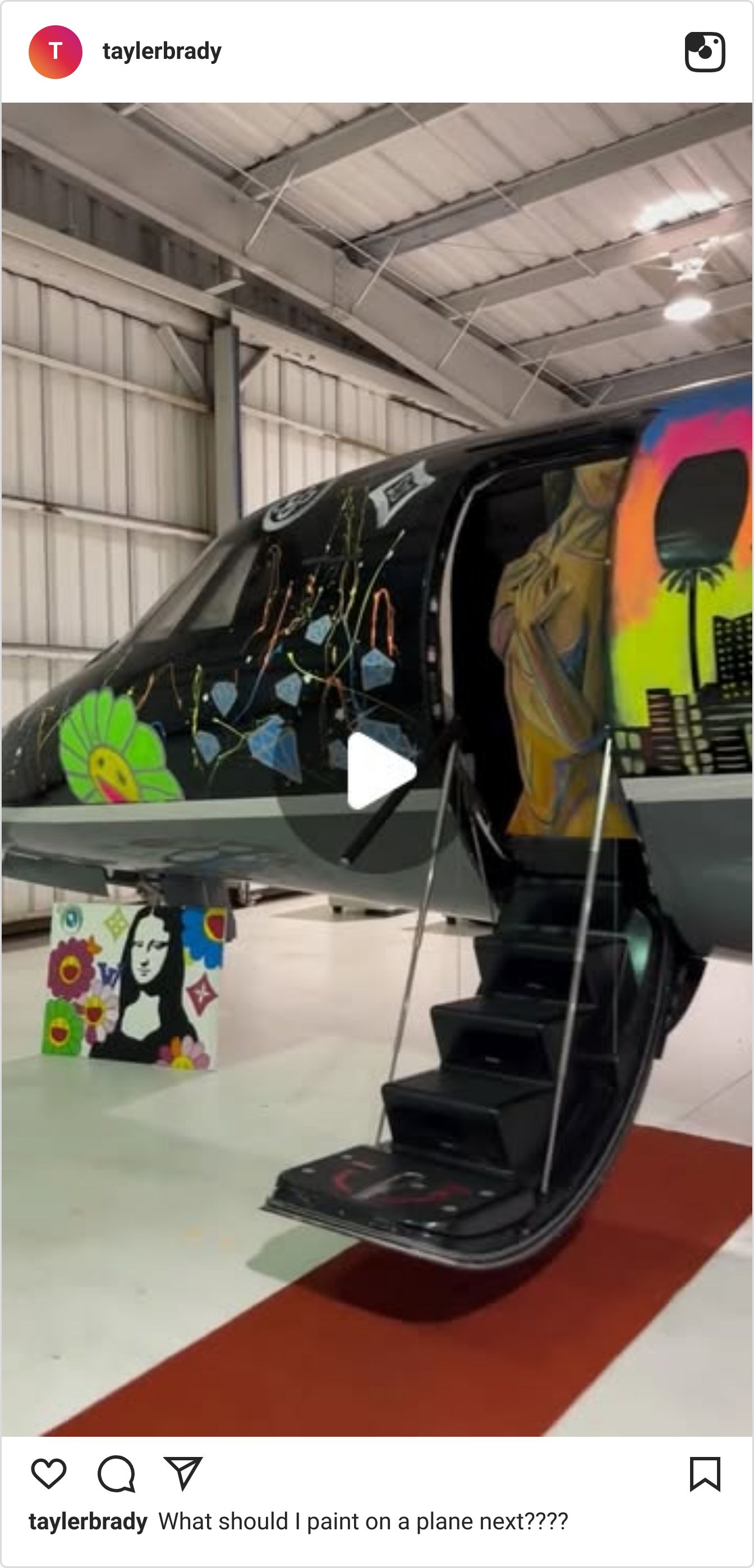
An aircraft turned up on our feeds this week wearing a very Miami art-inspired paint scheme, and the internet split cleanly down the middle. Jessie lives in South Florida and thought it was great. Preston got sent the outrage version. Our working theory is that this is a temporary application done for the camera before the airframe goes in to be stripped and painted properly, because the claim was that it went on in twenty-four hours, and nobody gives a shop twenty-four hours for a real paint job. Ask anyone who has waited on a slot. Either way it beats another white fuselage with a swoosh.
🎧 This Week's Episode
Missed the podcast? Catch up on the full episode at the links below! We would LOVE if you would give us a 5 star review, and share with your friends! And if you share a clip, please share the full segment rather than a short out-of-context cut. Context is our friend.
Listen: Apple Podcasts | Spotify | YouTube | Website
Jessie's Links:
Private Aviation Safety Alliance
FlyVizor
LinkedIn
Preston's Links:
Prestige Aircraft Finance
Private Jet Insider (Newsletter)
LinkedIn
X (Formerly Known as Twitter)
FastJets
Disclaimer: The VIP Seat Weekly is for informational and entertainment purposes only. Coverage of publicly traded companies reflects the personal opinions of the hosts and does not constitute investment, financial, tax, or legal advice, nor a recommendation to buy, sell, or hold any security. Commentary from our guest reflects his own views and analysis and is not legal advice for any particular structure. The hosts are not registered investment advisors and may hold positions in companies discussed. All investments carry risk. Readers should conduct their own research and consult a qualified financial professional before making any investment decision.


