

✈️ The VIP Seat Weekly
Your business aviation hot takes, served fresh.
August 12th, 2026 | Season 3 Episode 31 Companion
Good morning and welcome back to the VIP Seat. This week we battle it out over Wheels Up's second quarter numbers, ring the M&A gong for Solairus buying Clay Lacy's management and charter business, welcome Chris Rocheleau back to NBAA from the FAA, work out why NetJets stopped selling jet cards, look at REAL Jet turning on crypto payments, and close with the FAA funding a study on the devil's lettuce. Sit back, buckle up, and let's take off.
Listen Now: Spotify | Apple Podcasts | YouTube
Today's Newsletter is brought to you by AB Jets

Speaking of the shift to premium. Wheels Up is modernizing onto Challenger 300s and 350s, and good for them. But you know what they do not have yet? Challenger 3500s. Our sponsor does.
AB Jets did not just say they wanted new. They wanted new new. Brand new Challenger 3500s with Starlink, beautiful interiors, and everything else you would want when you are putting a high-end customer on an airplane.
Owner-operated since 1999, ARGUS Platinum since 2014. When the owners are the ones who built the operation from the ground up and are still running it today, the standard doesn't slip. Because it's their name on it. New Challenger 3500s, a fleet of Lear 60's that are reliable, and no owner approval requirements. A fleet optimized to say "yes" to your trips.
Give them a call when you need a really high-end experience for your charter customers. Thanks to AB Jets for sponsoring this season of The VIP Seat podcast!
Learn More At abjets.com
💰 Wheels Up Trims the Adjusted Losses

Gif by choicehotels on Giphy
The Scoop: Wheels Up reported Q2 earnings this week:
Revenue: $182.0 million (down 4 percent from $189.6 million YoY
Private jet flight revenue was roughly flat
Gross profit rose to $9.6 million from $2.2 million.
Net loss $107.2 million, or $2.97 per share, from $82.3 million (higher interest and aircraft lease costs plus a $12.7 million non-cash impairment tied to legacy fleet retirement)
Adjusted EBITDA loss $26.2 million and Adjusted EBITDAR loss of $19.9 million.
Total gross bookings $241.8 million (down 8%)
Live flight legs down 28% (in part blamed on sales process and technology inefficiencies)
Phenoms and Challengers grew from 22 to 40 aircraft year over year
Utility rose 20$
99.4$ completion rate and 86.8% on-time performance
Deferred revenue, largely prepaid jet card flights, stood at $626.9 million at quarter end, down from $687.6 million, while cash rose to $86.3 million and aircraft held for sale climbed to $64.4 million.
Our Take: What follows is observation and speculative opinion, not financial advice. We split hard on this one, so you get both sides.
Preston's read is that it was simply a bad number, and the usual defenses don't carry much weight. A non-cash impairment, fine, but at roughly ten percent of the net loss it is closer to a rounding error than an explanation. The financing costs are the part worth staring at, because expensive sale leaseback structures create a compounding problem. Lenders, lessors and bond buyers price you on whether they think you can pay them back. The longer the losses run, the higher that price goes, and the higher that price goes, the harder it gets to stop looking risky. Call it an interest expense spiral. Add SG&A that still feels high and at some point somebody has to start cutting things.
Jessie's read is that this is exactly what the middle of a fleet transition looks like. The legacy fleet had poor dispatch reliability and was not producing, and unwinding those agreements costs money before it saves any. Speaking as a former Phenom 300 operator, the economics on that airframe don't work until you are flying it hard: break even lands somewhere around 50 to 60 hours a month, and the real money doesn't show up until roughly 70 to 75 hours on a consistent basis. Quarter over quarter, utilization is climbing substantially. It is not there yet, but it is moving. The fleet build finished 18 months ahead of plan, which means the pilots, the aircraft and the fixed cost are all fully loaded now while the revenue catches up. The balance sheet is undeniably fragile, and absent Delta's backing the fundraising picture would look very different, but Delta does appear to be showing up.
Where we agree: Q4 is the exam. Demand across fractional and aircraft sales is running very hot right now, and if that does trickles into charter and they can’t capture that... well, not great. We also both think the pricing model is a self-inflicted wound. If a prospective jet card buyer cannot work out the cost of a trip without a zone chart and eight lines of pricing conditions, that is a customer experience problem, not a revenue management triumph. And the deferred revenue balance cuts both ways. Holding the cash is nice, but how much of it is owed against legacy programs, and what does the company give up converting those flyers to the premium product? Finally, on-time performance and zero-cancellation streaks are airline metrics being sold to a private aviation buyer who mostly just wants to know what the trip costs.
Read More: Private Jet Card Comparisons
🔔 Ring the M&A Gong: Solairus Buys Clay Lacy's Management and Charter Business

Gif by theoffice on Giphy
The Scoop: Solairus Aviation has agreed to acquire the aircraft management and charter divisions of Clay Lacy Aviation. Solairus currently manages approximately 360 aircraft from more than 100 base locations across North America, while the Clay Lacy divisions in the deal manage approximately 140. On completion, the combined operation would exceed 500 managed aircraft, which the companies describe as the world's largest managed fleet. Financial terms were not disclosed, and the transaction is expected to close at the end of September 2026 subject to regulatory approvals and customary closing conditions. Clay Lacy's FBO, maintenance and aviation real estate businesses are not part of the sale and will remain under the Clay Lacy name and current ownership. Solairus founder and CEO Dan Drohan said the transaction makes the company "the leading pure-play aircraft management company in the world." Forbes reported the combined charter fleet would number close to 200 aircraft, placing the merged entity among the largest US operators by charter hours. Clay Lacy was founded at Van Nuys in 1968; Solairus was founded in 2009 and is headquartered in Petaluma, California, with offices in Los Angeles and New York.
Our Take: We rang the M&A gong for this one, or we would have if Preston had packed it on his trip. Thanks to Oshman Aviation for sponsoring the gong. Sorry we didn’t have it on set.
The deal makes sense on its face. Scale is good in aircraft management, and once the infrastructure is built, adding tails is the easy part. The harder question is stickiness. Management contracts are famously portable. Watch how many contracts get picked off in the twelve months after close, because that number is the real price of the deal.
The thing we could not work out is the timing of the announcement. This was made public well ahead of closing. So what is the play here? Testing the news? Getting ahead of employee rumors? Seeing where the churn is before the ink dries? There is no easy way to do it, and we are curious rather than critical.
Two more things worth saying.
First, Solairus is much bigger than the public understands. They are quietly one of the largest operators in the country. Second, what changes hands in a deal like this is not just aircraft, it is operating history and safety culture. Both organizations have institutional memory, and the lessons a team carries forward are part of what the buyer is acquiring. That is a feature, not a footnote. Congratulations to everyone who made money here, and to friend of the pod Nick Fazzioli, who had a hand in putting it together.
Read More: Corporate Jet Investor
🏆 Rocheleau Heads Back to NBAA

Giphy
The Scoop: NBAA announced on July 30 that Christopher J. Rocheleau is returning to the association as chief operating officer. Rocheleau served as NBAA COO before his January 2025 appointment as acting administrator of the FAA, and continued as deputy administrator following the July 2025 confirmation of Bryan Bedford. As acting administrator, he led the agency through the aftermath of the January 29, 2025 midair collision involving a regional airliner and an Army helicopter near Reagan National, initiated a nationwide review to mitigate similar collision risks in complex airspace, and worked with Transportation Secretary Sean Duffy to accelerate air traffic controller hiring. As deputy, he supported development of the new air traffic control modernization effort and helped advance the MOSAIC initiative and the eVTOL integration pilot program. NBAA president and CEO Ed Bolen cited Rocheleau's record leading senior teams and his relationships across government and industry. Rocheleau joined NBAA in 2022 after more than two decades in FAA executive roles. In the COO seat he will oversee aircraft operations activities along with the association's administrative, financial, technical and human resources functions.
Our Take: Consider the timing, too. He went back to the FAA right after the DCA accident and right as an administration changed over, which is about as difficult a stretch as the agency has had in a generation. That is a lot of hard-won context walking back into the association.
Having someone in the building who knows how decisions on airspace, regulation, etc are made changes what NBAA can do inside a comment period. For our industry this is a win. NBAA also seems to be bolstering the ranks generally right now, and this is the second senior move in short order after Emily Deaton was hired in from Jet Aviva.
Read More: NBAA
💸 NetJets Pauses Jet Card and Lease Sales

Gif by cbc on Giphy
The Scoop: NetJets has paused new sales of its jet cards and leases. This is the second such pause in five years and the first since post-pandemic demand was the cause. The story was originally posted by Private Jet Card Comparisons and then confirmed by a few other outlets.
Our Take: Charter brokers and jet card salespeople, we love you, but you can retire the argument that nobody should buy a NetJets card because it is expensive. People know. Mathematically, on a per hour basis, it is the most expensive way to fly private short of owning an airplane and flying twenty hours a year. It is a premium product at a premium price. It is fine for more than one product to exist in a market.
Read More: Private Jet Insider
🪙 REAL Jet Turns On Crypto Payments for Charter

Giphy
The Scoop: REAL Jet, a REAL SLX company, has launched Crypto.com Pay on its charter booking platform, which the companies say makes it the first private aviation company to accept Crypto.com Pay for private charter flights. Customers with a Crypto.com account booking through REAL Jet can select the payment method at checkout, with transactions processed in compliance with applicable regulatory standards. The option is available to eligible US residents for bookings priced and settled in US dollars.
Our Take: Disclosure first: REAL Jet sponsors this newsletter, and we are covering this because it is news, not because they bought the slot. The interesting part here is distribution rather than currency. Crypto payment announcements in this industry have often been marketing more than plumbing, with a third party quietly converting to dollars before anything touches the operator. What makes this one worth a look is that a payments platform with a very large consumer user base is a customer acquisition channel, and charter's hard problem has never been accepting money. It has been finding first-time flyers ready to spend five figures on a trip.
Read More: Corporate Jet Investor
⚖️ The FAA Is Funding a Study on the Devil's Lettuce

Gif by buzzfeed on Giphy
The Scoop: The Transportation Research Board last month published details of an FAA-funded project to review cannabis use among pilots and air traffic controllers. Existing prohibitions remain fully in place: current policy bars marijuana use by pilots and other safety-sensitive aviation employees covered by DOT testing rules, and nothing about this review changes that. According to the FAA, the agency lacks validated criteria for determining when impairment has ended after cannabis use, and the review will examine how long effects may last, how that varies between users, and how test results relate to operational fitness.
Our Take: Before anything else, and we cannot say this loudly enough: this is not permission. If you are DOT covered and subject to drug testing, do not, do not, do not. You will get in very big trouble, and nothing about a research project changes that today or next year. Read the actual document, not the headline about it.
Two honest reservations. First, we are not optimistic about the outcome given how the FAA handles medication generally. This is an agency that makes life difficult over Benadryl. There is a long list of legal, genuinely helpful medications, antidepressants being the obvious one, where the certification process pushes people toward not disclosing, and it would be reasonable to work through those before turning to this. Four closed meetings with no public report also seems like a strange way to build trust in a safety standard the industry has to live with.
Read More: AVweb
Today's Newsletter is also brought to you by REAL JET

Relationships run the world, and our sponsor this week, RealJet, understands that. By creating a real relationship with a real person, something special happens. That's why they focus on creating unforgettable experiences with their sister company, Real SLX, to help deepen those relationships and create meaningful impressions on customers and vendors alike.
When you fly with RealJet, you are not a transaction. You are part of a community that has been serving private flyers for more than twenty-five years.
Learn More At realjet.com
🎰 Mile High Madness
Everyone Can Tell It's AI

Everyone knows you are using AI for your branding, none of us are falling for it, and it needs to stop. This is not a technology complaint, it is a taste complaint. Canva exists. Simple tools exist. Thanks to everyone who commented, because it made us laugh too.
The Rise of the Fictional Jet Influencer
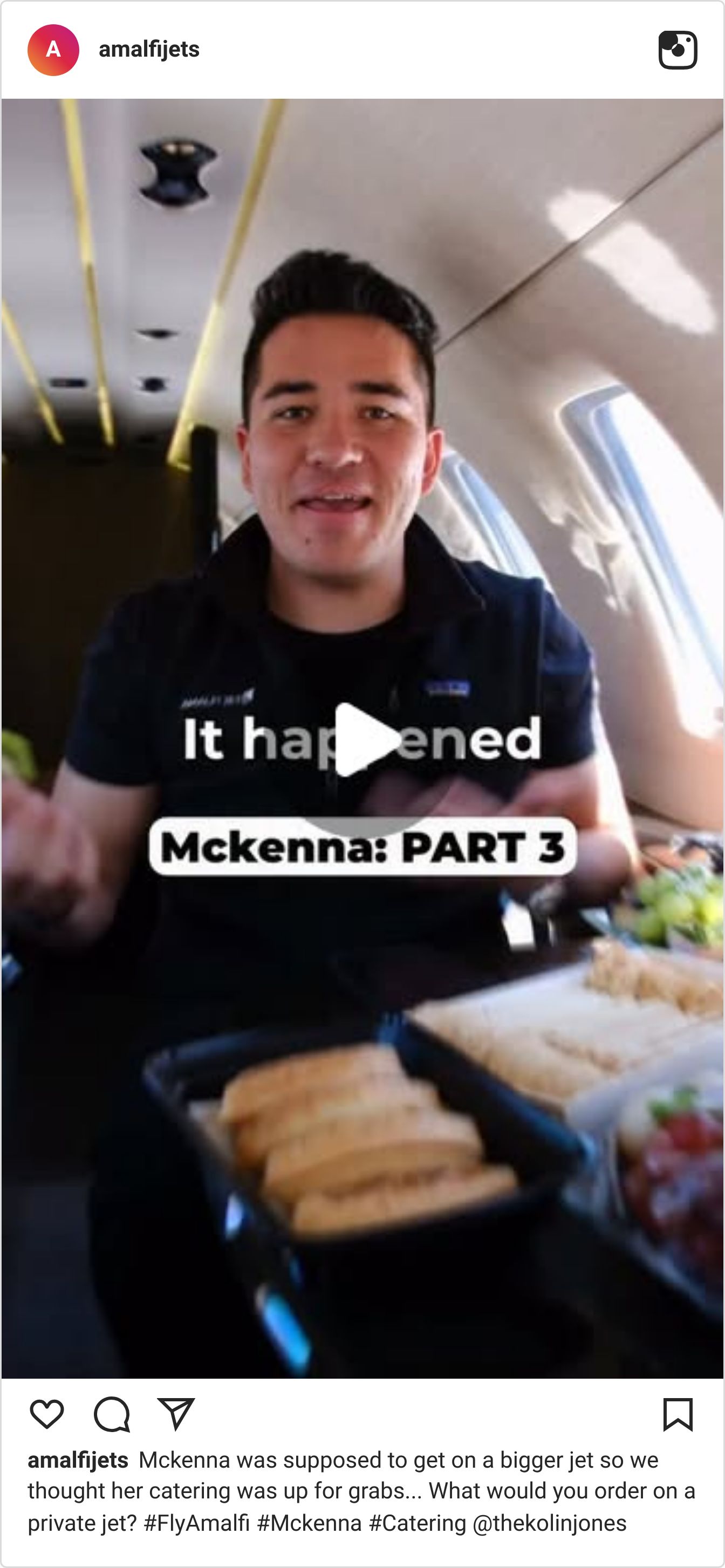
Rage bait with McKenna. It’s painful.
🎧 This Week's Episode
Missed the podcast? Catch up on the full episode at the links below! We would LOVE if you would give us a 5 star review, and share with your friends! And if you share a clip, please share the full segment rather than a short out-of-context cut. Context is our friend.
Listen: Apple Podcasts | Spotify | YouTube | Website
Jessie's Links:
Private Aviation Safety Alliance
FlyVizor
LinkedIn
Preston's Links:
Prestige Aircraft Finance
Private Jet Insider (Newsletter)
LinkedIn
X (Formerly Known as Twitter)
FastJets
Disclaimer: The VIP Seat Weekly is for informational and entertainment purposes only. Coverage of publicly traded companies reflects the personal opinions of the hosts and does not constitute investment, financial, tax, or legal advice, nor a recommendation to buy, sell, or hold any security. The hosts are not registered investment advisors and may hold positions in companies discussed. All investments carry risk. Readers should conduct their own research and consult a qualified financial professional before making any investment decision.
