

✈️ The VIP Seat Weekly
Your business aviation hot takes, served fresh
Season 2, Episode 25 | December 2nd, 2025 | Episode Companion
Welcome back to The VIP Seat. December is here, and we're kicking it off by calling out some bad math, celebrating some good art, and breaking down why institutional capital keeps knocking on business aviation's door. Plus: Airbus has a solar flare problem (maybe), Amazon's drones keep hitting things, and the FAA is finally putting trackers on ground vehicles.
This Week’s Episode is Brought To You By:

REAL Jet is redefining private aviation with a personalized, boutique approach designed for discerning travelers. With access to more than 1,500 premium aircraft and a commitment-free booking model, REAL Jet curates every trip around each flyer’s preferences. Backed by decades of industry expertise, REAL Jet upholds top-tier safety standards across all partner operators, including ARGUS and WYVERN certifications. The result is an effortless, elevated experience where every detail is intentional. REAL People. REAL Trust. REAL Jet.
🛫 The Runway Report
The top stories from this week's podcast that are moving the needle in bizav
📊 When Snopes Does Us a Favor

The private aviation industry doesn't get a lot of love from mainstream media, so when fact-checking website Snopes comes to our defense, we notice.
A certain Disney heiress has been making the rounds claiming that private jets account for 12% of U.S. air traffic, using this stat to argue for banning private aviation during discussions about ATC staffing issues. Snopes investigated and found the numbers don't add up. The source? A Chinese tabloid. The actual FAA data? Business aviation (which includes firefighting, air ambulance, and yes, private jets) made up about 9% of air traffic in 2024, and only 8% year-to-date in 2025.
Read The Article: Snopes
🛬 FAA Accelerates Surface Safety Tech
The FAA has been rolling out the Flight Line Surface Awareness Initiative, developed by uAvionix, which essentially gives ground vehicles the same visibility as aircraft. It's already live at 14 airports including Austin and Scottsdale, and the FAA just announced expansion to 55 more locations.
Why It Matters: Runway incursions are rare, but when they happen, the consequences can be catastrophic. As ground vehicles cross the runway, now the data can be seen live in the cockpit and create more safety checks as opposed to relying on ground control and flashing lights.
Read More: General Aviation News
✈️ Airbus Grounds Half the A320 Fleet (Solar Flares?)
Here's one that's still developing: Airbus has recalled approximately 6,000 aircraft, or around half of the A320 fleet, following an October 30th incident where a JetBlue flight from Cancun to Newark experienced an uncommanded pitch down at 35,000 feet. Passengers were injured and the aircraft made an emergency landing.
The issue traces to the Elevator Aileron Computer (ELAC2), which controls... well, the elevator and ailerons, arguably the most critical flight surfaces. The fix? About 4,000 aircraft have received a software patch (essentially reverting to older software), while roughly 1,000 need hardware replacements.
The Solar Flare Question: Some reports have attributed this to solar radiation corrupting data in the ELAC2 system. Here's the thing: there is some questions of whether solar radiation really caused the issue. Let’s wait for the official report to come out.
Our Take: Whether it's solar flares or a software bug, the fly-by-wire implications are real. Business aviation operates at even higher altitudes where space weather effects are more pronounced, and our aircraft are increasingly fly-by-wire. This is worth watching, but let's wait for the actual investigation before drawing conclusions. Kudos to Airbus for pushing fixes quickly.
Read More: Reuters
🚁 Amazon's Drone Delivery Hits Some Snags (Literally)
The FAA is investigating Amazon's Prime Air drone delivery program after multiple incidents, including one where an MK-30 drone got tangled in a customer's internet cable.
Amazon self-reported the incident (good) and paid for the repairs (also good). But this is one of three recent crashes… two others involved construction cranes in October.
The Technical Problem: The wire incident is almost understandable—even helicopter pilots hit wires, which is why helicopters have wire strike protection. But cranes? Sense and avoid issues are real for non piloted craft.
The deeper problem might be mapping. Wires and cables could, in theory, be mapped into flight paths. Cranes are variable, so sense-and-avoid should handle them. Neither worked.
The Regulatory Gap: Here's what's surprising… there's currently no requirement for commercial delivery drones to have ADS-B out. AOPA has raised concerns about drones operating beyond visual line of sight without the ability to be detected by crewed aircraft. An 85-pound drone (about the weight of a large Labrador, but pointier and less cuddly) hitting a low-flying helicopter is a serious concern. The rules are still being written.
Read More: The Hill
💰 Private Equity 101: Institutional Capital Eyes Aviation
Private Jet Card Comparisons published a report from Jeffries at CJI Miami signaling that institutional capital is making a significant push into business aviation. The focus? Roll-ups and platform companies… FBOs, MROs, and potentially aircraft management companies.
If you've been in this industry long enough, you've heard this before. But here's why this matters now:
The Deal Flow: Institutional investors (think Blackstone, KKR) typically won't touch companies below $200 million in value. The problem? Most aviation companies aren't there yet. This creates the "multiple arbitrage" game:
Mom and Pop operators (break-even to $5-10M EBITDA): Trade at 2-6x multiples
Mid-market consolidators ($50-100M+ EBITDA): Trade at 7-10x multiples
Institutional-ready platforms ($200M+): Even higher multiples, potential public market exits
Why This Is Good News: When institutional capital signals interest, it validates the entire ecosystem. Family offices and smaller PE firms who are currently aggregating smaller operators see that there's an exit path. That encourages activity at every level of the market.
The Caution: Financial investors aren't strategic partners. They don't have the same emotions, values, or long-term vision you might. Structure your deals carefully, and do everything you can to avoid a nightmare exit.
🤳 Mile High Madness
This week's wildest aviation content from social media
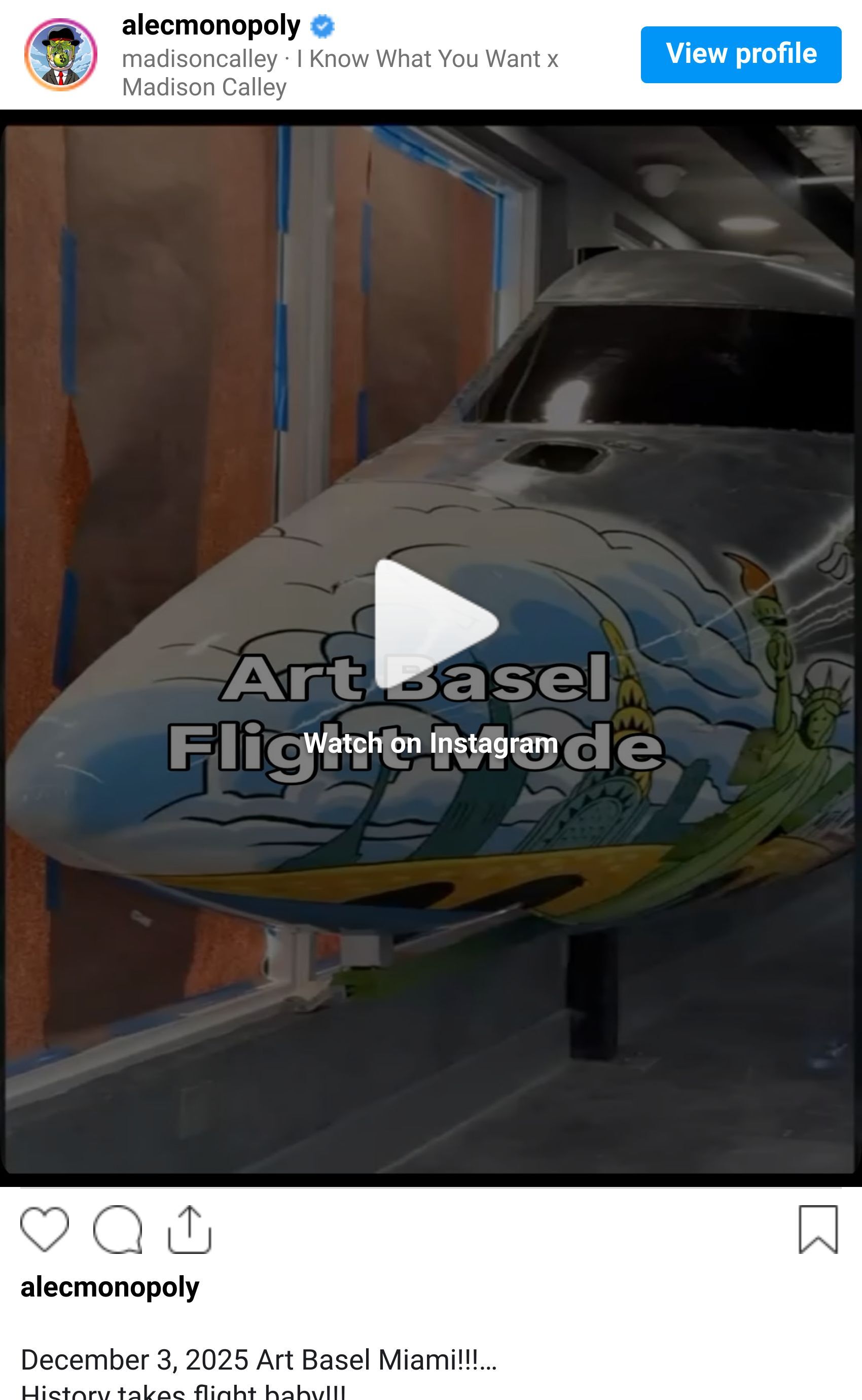
Art Basel Gets Aviation: If you're in Miami this week for Art Basel, check out Alec Monopoly's latest work. The graffiti artist known for his money-themed Monopoly character pieces is literally cutting up private jets and turning them into art.
LinkedIn Gets Spicy: Aviation attorney Amanda Applegate called out a broker who's been making written offers as a "buyer's agent" when he doesn't actually have a buyer. The play? Get the aircraft locked up, then go find a buyer on the back end and pocket a million or two in the middle. The comments section is doing detective work. See the post here.

🎧 This Week's Episode
Missed the podcast? Catch up on the full episode at the links below! We would LOVE if you would give us a 5 start review, and share with your friends!
Listen: Apple Podcasts | Spotify | YouTube | Website
The VIP Seat Weekly is the companion newsletter to The VIP Seat podcast. We give you the business aviation hot takes for your commute.
Jessie’s Links:
Private Aviation Safety Alliance
FlyVizor
LinkedIn
Preston’s Links:
Prestige Aircraft Finance
Private Jet Insider (Newsletter)
LinkedIn
X (Formerly Known as Twitter)
Jetting


